An experiment:
I would like to write more music, particularly choral music. I would prefer to do this on commission, for a whole bunch of reasons. But my music is not well-known, and so I don't attract attention from people who have serious money to pay for commissions, on the whole. So far, every note I have ever written has been for free.
What if the money for commissions isn't quite so serious?
For £30, I will set up to 50 words of English for SATB, with or without a simple organ or piano accompaniment. I'm willing to do more complex compositions, or simpler ones, or other languages, but please do contact me about it -- Latin is easy, Russian much harder! You can see (and in some cases hear) examples of my other compositions by using the look what I made tag on this blog. That isn't a full list (I'm working on it; processing works that pre-date this blog is another thing that is easily pushed aside!), but it's something.
Your chosen text must be in the public domain, or you must have permission from the appropriate sources for me to set it. The copyright of the finished work will remain with me but I will release it under a CC BY-SA license, meaning that others can use it freely in derivative works, even for commercial purposes, as long as they acknowledge my work and share it similarly. So if you commission a choral work from me, you won't just be contributing to my livelihood, you'll be contributing to a body of publicly available art.
Any takers?
Tuesday, 27 September 2011

Wednesday, 21 September 2011
Who do you say that I am?
Who is considered "Christian"? Why do any of us care?
Edward Green wrote an interesting post about the UCCF's Doctrinal Basis, a sort of pseudo-creed which it seems is sometimes used as a litmus test of who is "in" and who is not at university Christian Unions.
Revd Green rightly points out that even the Catechism of the Catholic Church has a broader remit than that, stating that “All who have been justified by faith in Baptism are incorporated into Christ; they therefore have a right to be called Christians, and with good reason are accepted as brothers in the Lord by the children of the Catholic Church.” I would agree that this is true, but I shy away from relying on the sacrament of baptism as a way of defining who is Christian, or rather, who is not.
The Salvation Army is one example of a non-sacramental movement that I would find difficult to classify as "not Christian". There are also Christian Quakers, and Christian Unitarians, and all sorts of people from all walks of life who consider themselves Christian in the sense of trying to follow the way of Jesus of Nazareth regardless of not sharing creedal beliefs. There are Mormons and Jehovah's Witnesses; I've lived with the former and been friends with the latter and I am not willing to call either group "not Christian" because of their divergences from the creed I give my heart to. Quite frankly, if someone believes in the Flying Spaghetti Monster but also self-identifies as Christian I am willing to consider them Christian.
There are a few reasons I have this attitude. One is that I believe God is ultimately ineffable and limitless. This puts everyone in a bit of a pickle as it's difficult to say anything meaningful about the nature of God without putting limits on God. If God is pink then God cannot be blue, but if God is limitless then God is both pink and blue. So while I am concerned with right belief, I try to sit lightly to it, if you will, remembering that we are all heretics.
Another reason is that the example Jesus set for us, if I am to believe scripture, points toward accepting others and treating them with respect and loving kindness regardless of their religious background. What is the point of my knowing what sort of Christian someone is? So often, this seems to be a case of trying not to associate with the "wrong" sort of people.
Sometimes this is out of a concern for sacramental purity: only baptised, confirmed Christians who have jumped through this hoop and that hoop are welcome at the Lord's table, says the Church. We mustn't "adulterate" the sacrament by allowing anyone who might have the wrong idea to try it for themselves, or by allowing anyone we aren't quite sure about -- sinners, gays, women -- to preside at the Eucharist. I think this is incredibly sad; we are all heretics, remember? and I would say we are also all sinners! But Jesus ate with society's outcasts and died as an outcast himself. He asked people to believe in him, but didn't demand they believed before feeding them. I have better things to do than try to follow obscure rules about who I may or may not eat with.
Sometimes the purity concerns seem to be more along the lines of worry that someone will come along and infect us with wrong belief. I can understand this a little better. If you have a nice comforting belief and someone comes along and questions the premises, then of course it's going to be unnerving. But scary and evil aren't the same thing, and building isolating walls around our faith does two things: it puts the community at risk of stagnation and idiosyncracy, and it gives people leverage over us. Now, I do think that people in community should give one another power; we are accountable to each other, we live together on this interconnected planet where there is only one flesh we can wound. But I don't think that power should extend as far as someone saying "Well, you aren't really Christian if you believe that. You don't belong here."
At Greenbelt, I went to a talk by Mark Vernon on fundamentalisms and boundaries. He described the difference between bounded sets and centred sets by talking about ways of keeping herds of cattle together in Australia. There are basically two strategies: you can build a fence, or you can sink a well. Then in the rest of his talk he went on to talk about how some people seem to need boundaries, how without boundaries we can't define what the church is or isn't and cross those boundaries to reach -- who? Other churches? the "unchurched"? I don't quite remember, to be honest, because for the rest of the talk I was thinking "OK, but what happens if we just sink a well?"
Boundaries make us feel safe, right enough, whether that's to do with purity of thought or purity of sacrament. It's natural enough to want to associate with the "right" kind of people. But dividing the sheep and the goats by doctrinal fences isn't, in the end, for us to do. The wheat and tares are not for us to sort out.
Instead we are told "by their fruits ye shall know them" and "love your neighbour as yourself". I hope that if people classify me as Christian it is not because I go to church to pray, or because I regularly receive Communion, or because I happen to agree with them on matters of doctrine or liturgy. When someone tells me that they are Christian, I consider it a statement of intent, not a statement of adherence to some orthodoxy or another. I am not a theologian and some would say I lack the education to make such assumptions. Nevertheless, I hope that if people classify me as Christian, it is because of my attempts, however frail or flawed the results might be, to live in the world as an example of God's love for the world.
Edward Green wrote an interesting post about the UCCF's Doctrinal Basis, a sort of pseudo-creed which it seems is sometimes used as a litmus test of who is "in" and who is not at university Christian Unions.
Revd Green rightly points out that even the Catechism of the Catholic Church has a broader remit than that, stating that “All who have been justified by faith in Baptism are incorporated into Christ; they therefore have a right to be called Christians, and with good reason are accepted as brothers in the Lord by the children of the Catholic Church.” I would agree that this is true, but I shy away from relying on the sacrament of baptism as a way of defining who is Christian, or rather, who is not.
The Salvation Army is one example of a non-sacramental movement that I would find difficult to classify as "not Christian". There are also Christian Quakers, and Christian Unitarians, and all sorts of people from all walks of life who consider themselves Christian in the sense of trying to follow the way of Jesus of Nazareth regardless of not sharing creedal beliefs. There are Mormons and Jehovah's Witnesses; I've lived with the former and been friends with the latter and I am not willing to call either group "not Christian" because of their divergences from the creed I give my heart to. Quite frankly, if someone believes in the Flying Spaghetti Monster but also self-identifies as Christian I am willing to consider them Christian.
There are a few reasons I have this attitude. One is that I believe God is ultimately ineffable and limitless. This puts everyone in a bit of a pickle as it's difficult to say anything meaningful about the nature of God without putting limits on God. If God is pink then God cannot be blue, but if God is limitless then God is both pink and blue. So while I am concerned with right belief, I try to sit lightly to it, if you will, remembering that we are all heretics.
Another reason is that the example Jesus set for us, if I am to believe scripture, points toward accepting others and treating them with respect and loving kindness regardless of their religious background. What is the point of my knowing what sort of Christian someone is? So often, this seems to be a case of trying not to associate with the "wrong" sort of people.
Sometimes this is out of a concern for sacramental purity: only baptised, confirmed Christians who have jumped through this hoop and that hoop are welcome at the Lord's table, says the Church. We mustn't "adulterate" the sacrament by allowing anyone who might have the wrong idea to try it for themselves, or by allowing anyone we aren't quite sure about -- sinners, gays, women -- to preside at the Eucharist. I think this is incredibly sad; we are all heretics, remember? and I would say we are also all sinners! But Jesus ate with society's outcasts and died as an outcast himself. He asked people to believe in him, but didn't demand they believed before feeding them. I have better things to do than try to follow obscure rules about who I may or may not eat with.
Sometimes the purity concerns seem to be more along the lines of worry that someone will come along and infect us with wrong belief. I can understand this a little better. If you have a nice comforting belief and someone comes along and questions the premises, then of course it's going to be unnerving. But scary and evil aren't the same thing, and building isolating walls around our faith does two things: it puts the community at risk of stagnation and idiosyncracy, and it gives people leverage over us. Now, I do think that people in community should give one another power; we are accountable to each other, we live together on this interconnected planet where there is only one flesh we can wound. But I don't think that power should extend as far as someone saying "Well, you aren't really Christian if you believe that. You don't belong here."
At Greenbelt, I went to a talk by Mark Vernon on fundamentalisms and boundaries. He described the difference between bounded sets and centred sets by talking about ways of keeping herds of cattle together in Australia. There are basically two strategies: you can build a fence, or you can sink a well. Then in the rest of his talk he went on to talk about how some people seem to need boundaries, how without boundaries we can't define what the church is or isn't and cross those boundaries to reach -- who? Other churches? the "unchurched"? I don't quite remember, to be honest, because for the rest of the talk I was thinking "OK, but what happens if we just sink a well?"
Boundaries make us feel safe, right enough, whether that's to do with purity of thought or purity of sacrament. It's natural enough to want to associate with the "right" kind of people. But dividing the sheep and the goats by doctrinal fences isn't, in the end, for us to do. The wheat and tares are not for us to sort out.
Instead we are told "by their fruits ye shall know them" and "love your neighbour as yourself". I hope that if people classify me as Christian it is not because I go to church to pray, or because I regularly receive Communion, or because I happen to agree with them on matters of doctrine or liturgy. When someone tells me that they are Christian, I consider it a statement of intent, not a statement of adherence to some orthodoxy or another. I am not a theologian and some would say I lack the education to make such assumptions. Nevertheless, I hope that if people classify me as Christian, it is because of my attempts, however frail or flawed the results might be, to live in the world as an example of God's love for the world.
Thursday, 8 September 2011
Lost Link
Some time ago -- a year, two years? -- I came across an article on the technical demands of music. I think it might have been linked to from Elaine Fine's blog, Musical Assumptions (to which I commend you anyway), but I can't find it there.
I remember quite clearly that it used a typing analogy, comparing playing music to copy-typing, but in a specific rhythm, in time with others, with precise pressure on each key according to how bold the letters are on the page, and having to get everything right. It went into more detail than that and explained the process far better than I can.
I can't find it anywhere. Has anyone seen it?
I remember quite clearly that it used a typing analogy, comparing playing music to copy-typing, but in a specific rhythm, in time with others, with precise pressure on each key according to how bold the letters are on the page, and having to get everything right. It went into more detail than that and explained the process far better than I can.
I can't find it anywhere. Has anyone seen it?
Sunday, 4 September 2011
Ssssssomething a little different
I'm trying to find more local teaching. Rather than having the same old boring poster for piano lessons I thought I'd advertise a bit differently...

I've chopped off the bottom line for security reasons as I don't want my telephone number all over the internet, but please leave a comment or contact me via twitter if you are interested in lessons!
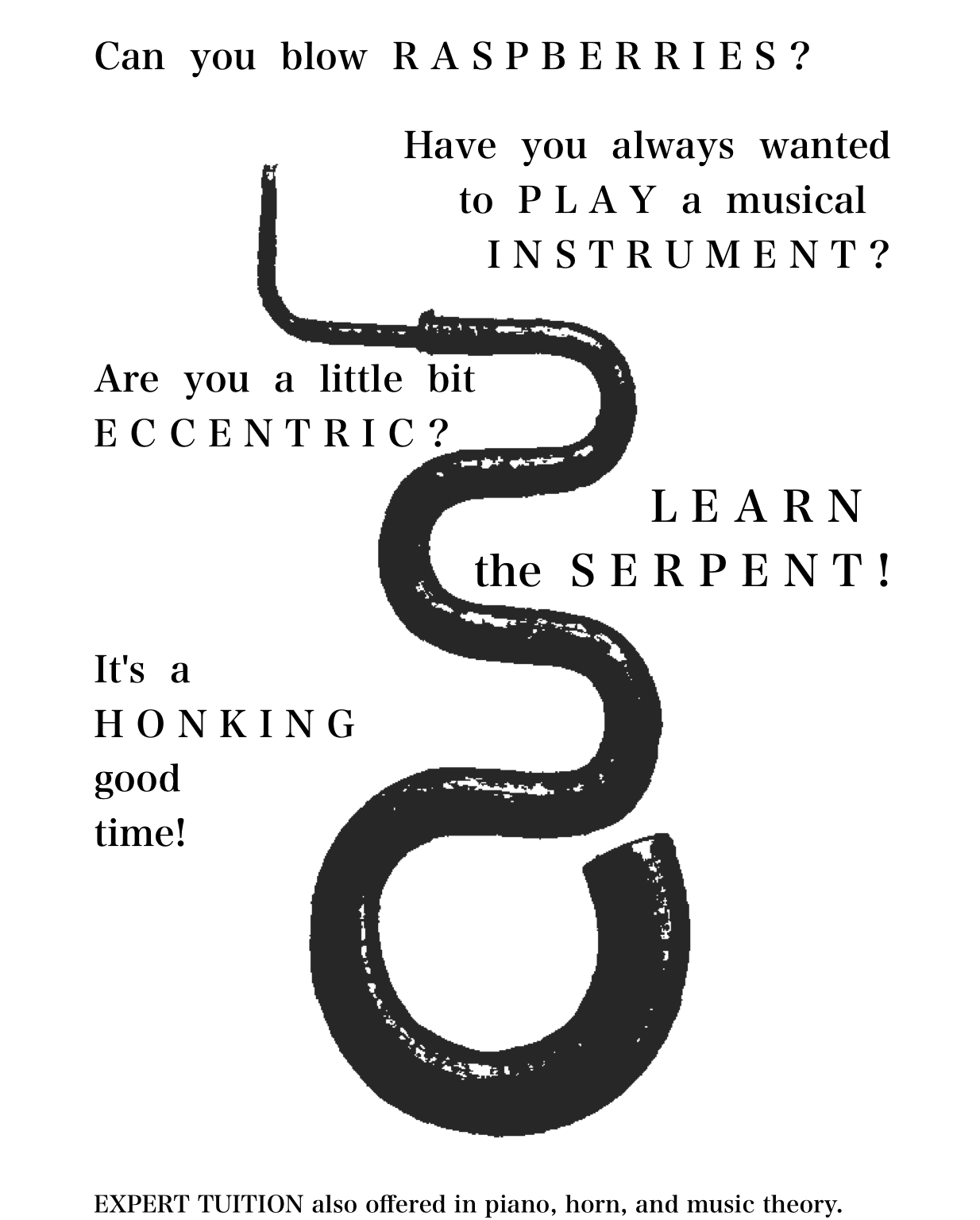
I've chopped off the bottom line for security reasons as I don't want my telephone number all over the internet, but please leave a comment or contact me via twitter if you are interested in lessons!
Wednesday, 31 August 2011
Song for October Ending
In around 2006 I wrote this SATB setting of a poem by my grandmother. The weather is a bit autumnal here today and a few people were talking about things they like about autumn, so I thought I'd post it even though it's two months early.
SONG FOR OCTOBER ENDING
For a season
cold rain imprisons us; our lives
circle around coffee cups,
blue teapots,
things simmering on the stove,
baking in the oven.
We
make jams, jellies and
press
radiant leaves
between slices of waxed paper.
Preserve the days.
Warmth imprints our lives
Warmth is the imprint
of our love.
----
I haven't made a recording, I ought to work on that at some stage.
SONG FOR OCTOBER ENDING
For a season
cold rain imprisons us; our lives
circle around coffee cups,
blue teapots,
things simmering on the stove,
baking in the oven.
We
make jams, jellies and
press
radiant leaves
between slices of waxed paper.
Preserve the days.
Warmth imprints our lives
Warmth is the imprint
of our love.
----
I haven't made a recording, I ought to work on that at some stage.
Thursday, 18 August 2011
Psalter Commons
I have a new project! It's called Psalter Commons and I would love your help with it.
I'd like the words of the psalms to be freely available for liturgy and study, but copyright law means the only truly free translations are quite old.
If you have translated or paraphrased a psalm or many psalms, please feel free to add the texts! They don't need to have music, though if you do have music that's great too. If you know of existing public domain psalters not listed on the category page please add those, too, preferably with links. Using a wiki is easy and quicky, er, quick.
More background details:
I have often whinged about the lack of freely-accessible, modern-language, metrical settings of psalms available these days. The older psalms available in the public domain are glorious! I do love them, and I'm very glad to have a chance to sing them fairly regularly in London Gallery Quire (though I play the serpent more often than I sing, I still get to read the words as I usually play from a vocal score). However, the language is considered archaic by many, and in some cases the translations are a bit suspect too, compared to modern scholarship.
There are modern metrical translations. Some of them are even included in the Christian Copyright Licensing Initiative (CCLI), which means that for a fee and with a lot of paperwork, we're allowed to make copies of the words -- if we've already bought a copy of whatever book they're in. That's admirable, but for a small parish like St Andrew's it's still a pretty high barrier to use. Why not just release them under a CC-BY-SA license and let everyone use them? Then I would be able to write my own musical settings if I wanted to, or set them to existing hymn tunes where appropriate.
There are accessibility difficulties with prose translations, too. The Common Worship Psalter publication terms aren't too bad for liturgical use but if I want to use that material in a separate piece of music I have to write an ask for permission. The Coverdale psalms which are usually bound with the Book of Common Prayer, and those in the King James Authorised Version of the bible, are commonly thought to be in the public domain, but in the UK they're actually under strange special copyright laws which mean that, again, I would need to ask for permission to use them.
So, I was having my usual moan and a friend offered to set up and host a wiki. It seemed like a better idea than just whingeing, so I said yes.
I hope that Psalter Commons will eventually become a valuable resource for anyone interested in the psalms for study and liturgical purposes. It will take a lot more work than I could do myself, which is why a wiki makes so much sense -- now others who are interested can join in. Please do, and please send this page to others who might be interested.
I'd like the words of the psalms to be freely available for liturgy and study, but copyright law means the only truly free translations are quite old.
If you have translated or paraphrased a psalm or many psalms, please feel free to add the texts! They don't need to have music, though if you do have music that's great too. If you know of existing public domain psalters not listed on the category page please add those, too, preferably with links. Using a wiki is easy and quicky, er, quick.
More background details:
I have often whinged about the lack of freely-accessible, modern-language, metrical settings of psalms available these days. The older psalms available in the public domain are glorious! I do love them, and I'm very glad to have a chance to sing them fairly regularly in London Gallery Quire (though I play the serpent more often than I sing, I still get to read the words as I usually play from a vocal score). However, the language is considered archaic by many, and in some cases the translations are a bit suspect too, compared to modern scholarship.
There are modern metrical translations. Some of them are even included in the Christian Copyright Licensing Initiative (CCLI), which means that for a fee and with a lot of paperwork, we're allowed to make copies of the words -- if we've already bought a copy of whatever book they're in. That's admirable, but for a small parish like St Andrew's it's still a pretty high barrier to use. Why not just release them under a CC-BY-SA license and let everyone use them? Then I would be able to write my own musical settings if I wanted to, or set them to existing hymn tunes where appropriate.
There are accessibility difficulties with prose translations, too. The Common Worship Psalter publication terms aren't too bad for liturgical use but if I want to use that material in a separate piece of music I have to write an ask for permission. The Coverdale psalms which are usually bound with the Book of Common Prayer, and those in the King James Authorised Version of the bible, are commonly thought to be in the public domain, but in the UK they're actually under strange special copyright laws which mean that, again, I would need to ask for permission to use them.
So, I was having my usual moan and a friend offered to set up and host a wiki. It seemed like a better idea than just whingeing, so I said yes.
I hope that Psalter Commons will eventually become a valuable resource for anyone interested in the psalms for study and liturgical purposes. It will take a lot more work than I could do myself, which is why a wiki makes so much sense -- now others who are interested can join in. Please do, and please send this page to others who might be interested.
Tuesday, 9 August 2011
Alive and well.
I'm not in London at the moment, and where I am is perfectly safe.
St Andrew's Leytonstone will be open tomorrow from 11am to 3pm for prayer and for discussing concerns and responses to the London riots.
I might do a more in-depth post later. In the meantime if you want to help please see http://wiki.crisiscommons.org/wiki/London_Riots for information on how to do so.
Subscribe to:
Posts (Atom)